The neighboring market your company can reach next
A quick overview of Uruguay for Brazilian companies planning to expand into this market — and how ORBE coordinates that move through its network of local partners.
We help Brazilian companies set up and operate in Uruguay, with one point of contact from strategy to the first day of operations.
If your company is evaluating an operation in Uruguay, we help you understand the market, choose the right structure and map out the requirements to operate locally — company formation, tax registration, local address and the documents each step requires.
We coordinate the process with a trusted network of local partners — accountants, lawyers and specialized providers — so your team doesn't have to manage each supplier on its own, in another language and under another legal system.
With 19 years supporting companies in Brazil, ORBE helps your company start in Uruguay lean, validate the market and scale its structure as the operation grows.
A quick overview of Uruguay
Capital
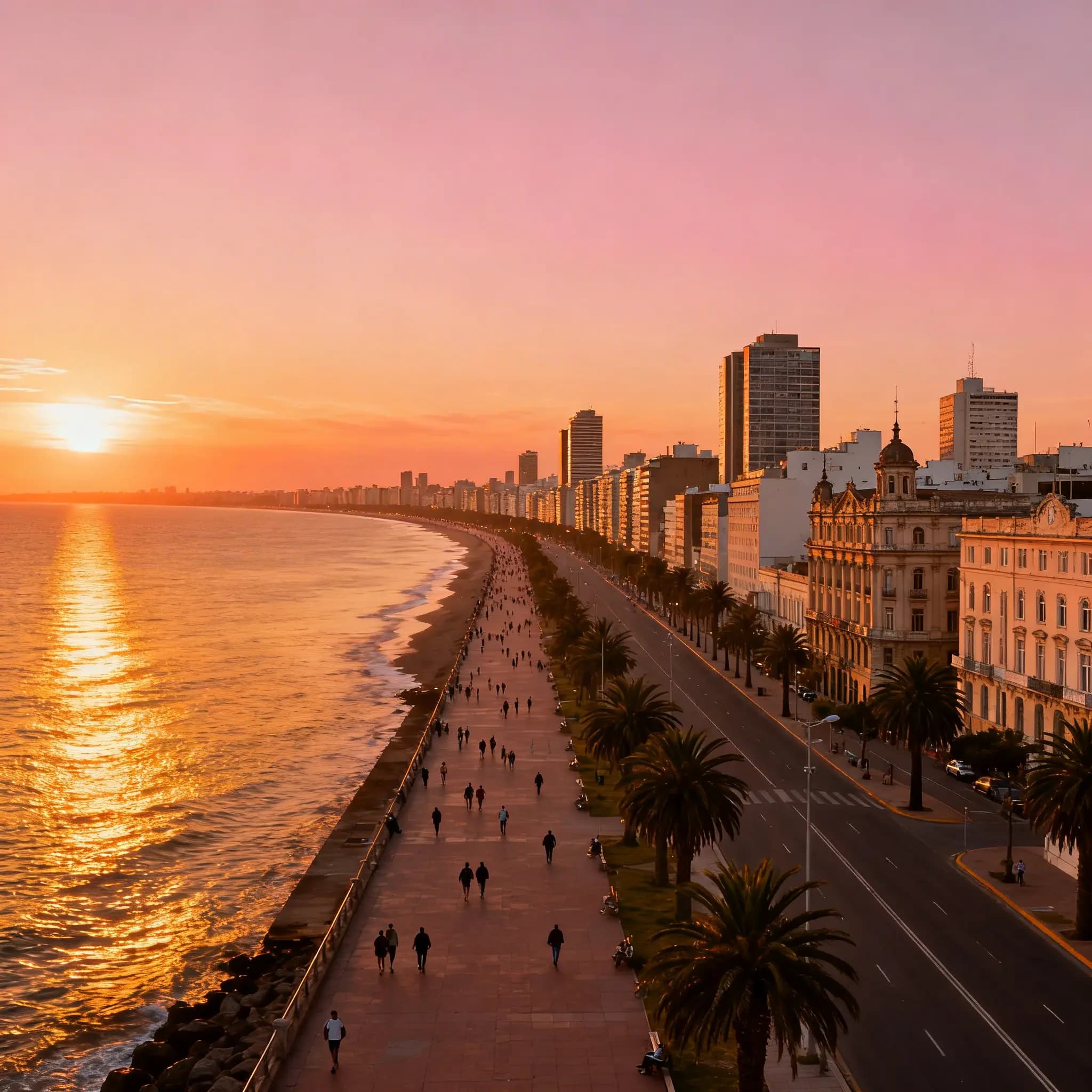
Montevideo is the capital of Uruguay, seat of government and the country's main economic, port and population center.
Currency
The Uruguayan Peso (UYU) is the official currency, issued by the Central Bank of Uruguay — the US dollar is also widely used in contracts and real estate.
Climate
Temperate, with no defined dry season, mild to warm summers and cool winters — milder than much of South America.
Context, culture and fun facts before you arrive
About Uruguay
Uruguay is a presidential republic with around 3.5 million people, one of the smallest countries in South America by area.
It is a founding member of Mercosur, alongside Brazil, Argentina and Paraguay, and is often cited as one of the most institutionally stable countries in the region.
Geography and regions
The territory is mostly flat, made up of pampas and gentle hills, with an extensive coastline on the Río de la Plata and the Atlantic Ocean.
Montevideo concentrates a large share of the country's population and economic activity, including its main port.
Culture and people of Uruguay
Spanish is the official language, with a strong influence from European immigration — especially Spanish and Italian — on culture and cuisine.
Mate is a widespread social habit, and the country has a history of regional leadership in social rights and secular policies.
Fun facts
Uruguay regularly ranks among the Latin American countries with the lowest perceived corruption and the highest democratic stability.
The country's free trade zones, with their special tax regime, are a well-known draw for foreign companies seeking a regional base.
National holidays
Uruguay observes fixed and movable national holidays, as well as widely celebrated dates such as Carnival and Tourism Week (Holy Week).
| Holiday | Date | Type |
|---|---|---|
| New Year's Day | January 1 | Fixed |
| Carnival | February or March (varies) | Movable |
| Tourism Week (Holy Week) | March or April (varies) | Movable |
| Landing of the 33 Orientals | April 19 | Fixed |
| Labor Day | May 1 | Fixed |
| Battle of Las Piedras | May 18 | Fixed |
| Declaration of Independence | August 25 | Fixed |
| Day of the Americas / Cultural Diversity | October 12 | Fixed |
| Christmas | December 25 | Fixed |
Keep this calendar in mind when planning administrative deadlines and business operations with local partners.
Tell us about your project
Fill in the details below so our team can understand your needs before the first conversation.